
GPS Antenna Guide: How to Choose a GNSS Antenna
Active or passive, single or dual band, patch or helix, CRPA or not: the specifications that decide which GPS / GNSS antenna fits your platform.

The antenna is the first and often the most decisive part of a GPS receiver chain. Satellite signals reach the ground at around −130 dBm, so any gain, noise or pattern problem at the antenna is passed on to everything after it. Choosing the right GPS — or more precisely GNSS — antenna means matching frequency bands, gain, noise figure, pattern and ruggedness to the platform and the threat environment.
GPS antenna or GNSS antenna?
GPS is the United States’ satellite system; GNSS is the general term that also covers Galileo, GLONASS and BeiDou. A modern “GPS antenna” is usually a GNSS antenna: it receives several constellations, which gives the receiver more satellites, better geometry and more resilience when some signals are blocked or attacked.
Frequency bands: single-band or dual-band
Upper L-band (roughly 1559–1610 MHz) carries GPS L1, Galileo E1, BeiDou B1 and GLONASS G1. Lower L-band (roughly 1164–1300 MHz) carries L2, L5 and E5. A dual-band antenna lets the receiver correct ionospheric errors for better accuracy and keeps navigation available if one band is jammed.
Active vs passive antennas
An active antenna contains a low-noise amplifier (LNA) powered through the coaxial cable. It compensates for cable loss and sets the noise figure of the whole chain, so it is the normal choice when the antenna is mounted away from the receiver — on a vehicle roof, a mast or a UAV airframe. A passive antenna has no amplifier and only suits very short cable runs.
- LNA gain: enough to overcome cable and splitter losses, without overloading the receiver
- Noise figure: as low as possible — around 1.5 dB or better for a good active antenna
- Supply range: wide input voltage simplifies integration with different receivers
- Out-of-band filtering: protects the LNA from strong nearby transmitters
Polarisation, gain and pattern
GNSS signals are right-hand circularly polarised (RHCP). A good antenna keeps a low axial ratio toward the zenith and rejects left-hand signals, which helps against multipath reflected from the ground and nearby structures. The pattern should cover the full sky down to low elevations, but strong gain right at the horizon also lets in ground-based interference — a trade-off that matters in contested areas.
Ruggedness and installation
- Ingress protection — IP67 or IP68 for permanent outdoor installation
- Temperature range suited to the platform, for example −55 … +85 °C
- Connector type (TNC, SMA) and cable length
- Size and weight on small UAVs, ground plane and a clear view of the sky
When a standard GPS antenna is not enough
In areas where jamming is expected, even an excellent standard antenna will lose lock once interference rises above the signal. A CRPA (controlled reception pattern antenna) array uses several elements and adaptive processing to place nulls toward jammers. A passive shield such as the SAJ GNSS Shield attenuates low-elevation signals by 20–30 dB and can be fitted around an existing antenna. Our guides on CRPA antennas and on GNSS jamming vs spoofing explain these options in detail.
Sağlamtek GNSS antennas
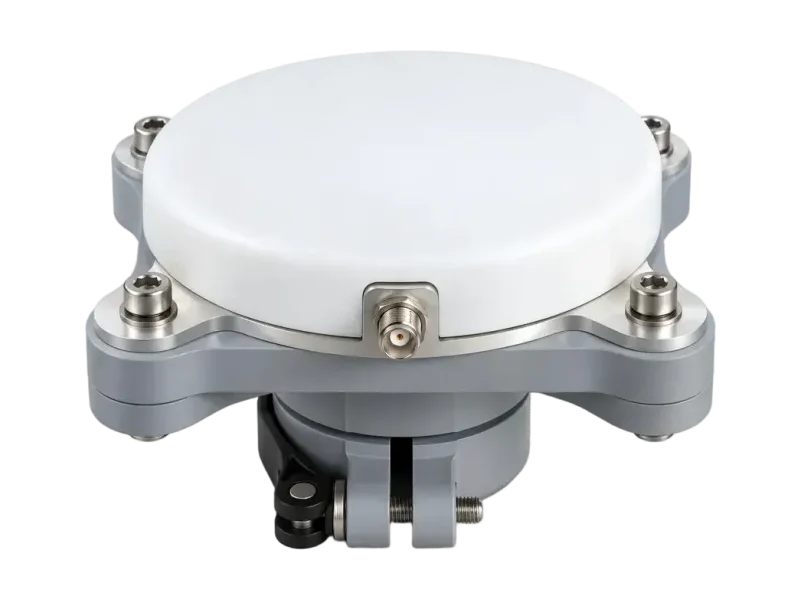
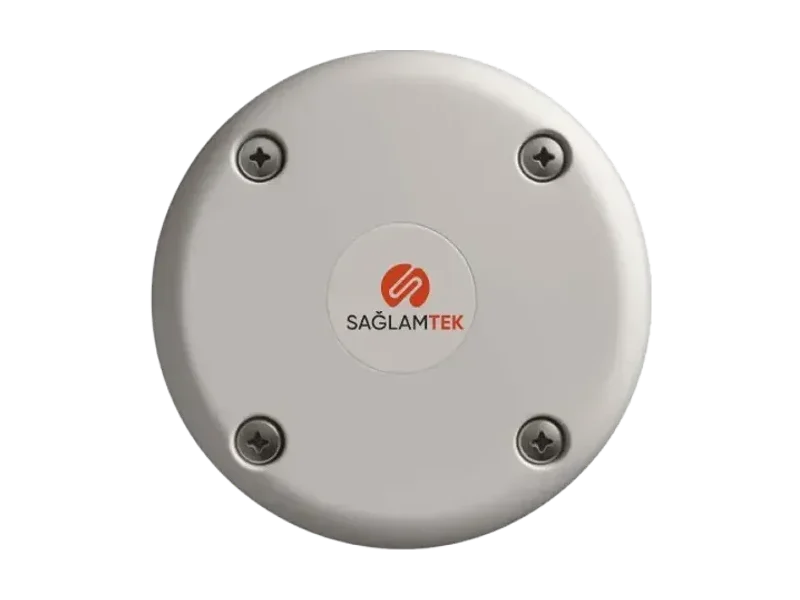
Sağlamtek’s GNSS Active Antenna covers upper and lower L-band with RHCP polarisation, 3 dBic gain, a 40–45 dB LNA with a noise figure below 1.5 dB, a 3–28 VDC supply, a TNC connector and an IP68 housing rated from −55 °C to +85 °C. The compact GNSS Active Antenna-2 offers the same bands in an Ø 89 × 25 mm IP67 housing under 290 g for UAVs and ground robots. For contested environments, the BORAJ CRPA family and the SAJ GNSS Shield add anti-jam protection.

Written by
Sağlamtek Engineering Team
RF, antenna & navigation engineering · Ankara
Articles on this blog are written by the engineers who design, test and build Sağlamtek’s anti-jam GNSS, RF, antenna and radar products at our R&D Center and manufacturing facility in Ankara.